Blog
Eating faeces: an unsavoury habit most owners would rather not associate with their dog. Certainly when that loyal four-legged friend gives you an affectionate lick in the face five minutes later.
When an owner brings up this behaviour during a consultation, then alongside all possible behavioural advice it is certainly worth taking a close look at the dog’s diet as well. That this can be worthwhile is made crystal clear by the case of Scoop below.
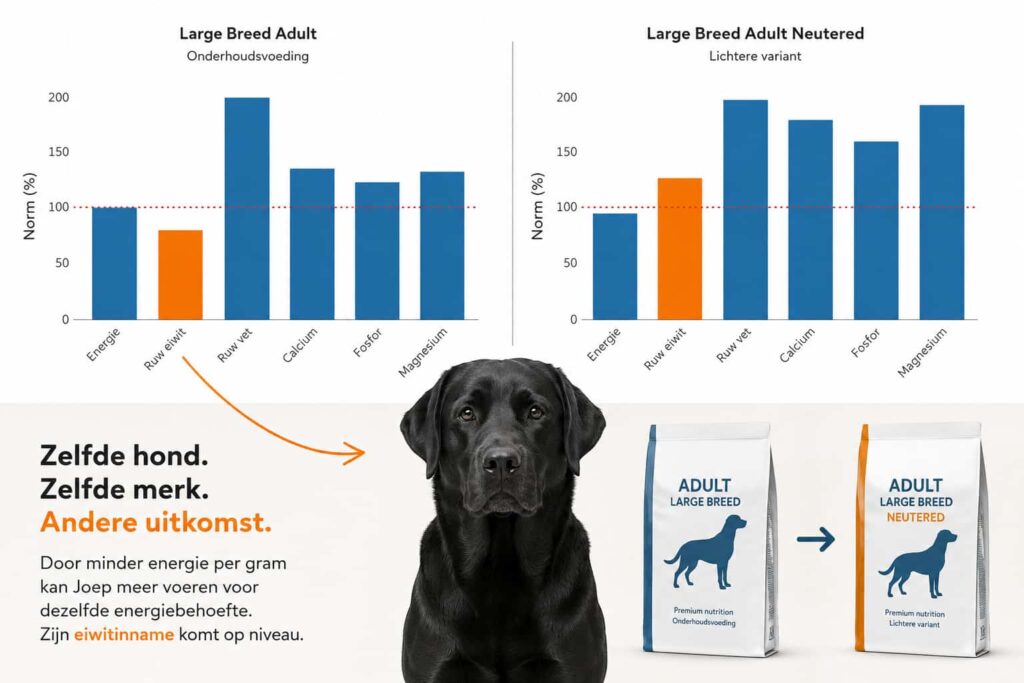
Scoop, a good-natured 36 kg Labrador on the heavy side, had recently started eating faeces. His owner fed him a good-quality premium maintenance diet for large breeds — but 20% less than the guideline on the bag, because he would otherwise gain even more weight.
It was decided to run a feed analysis through FeedWise, and it quickly became visible what was happening: with the restricted daily portion, Scoop was getting not only less energy but also fewer nutrients. At this amount, his protein intake fell below the recommended level.
Within the same brand, the suitability of the neutered variant was then assessed. Thanks to its lower energy density and higher protein content, Scoop could eat more — and took in considerably more protein.
And remarkably: the poop eating stopped, within just a few days.
Does this prove beyond doubt that a suboptimal protein intake was THE cause? Not directly — the new diet also contained more fibre and less fat. But such a low protein intake, or low-quality protein, can theoretically be a trigger for a dog to go looking for extra protein. And where is plenty of residual protein still found? Exactly: in faeces.
The moral of this case: with this kind of behaviour, it pays to scrutinise the diet as well. Is the animal getting enough nutrients from its daily ration?
That is exactly where FeedWise can help you. And you will be surprised how often there is room for improvement.
After all, it is not just about what you feed, but also how much you feed — and whether that amount actually covers the nutrient requirements.
Do you routinely consider nutrition when faced with coprophagia?